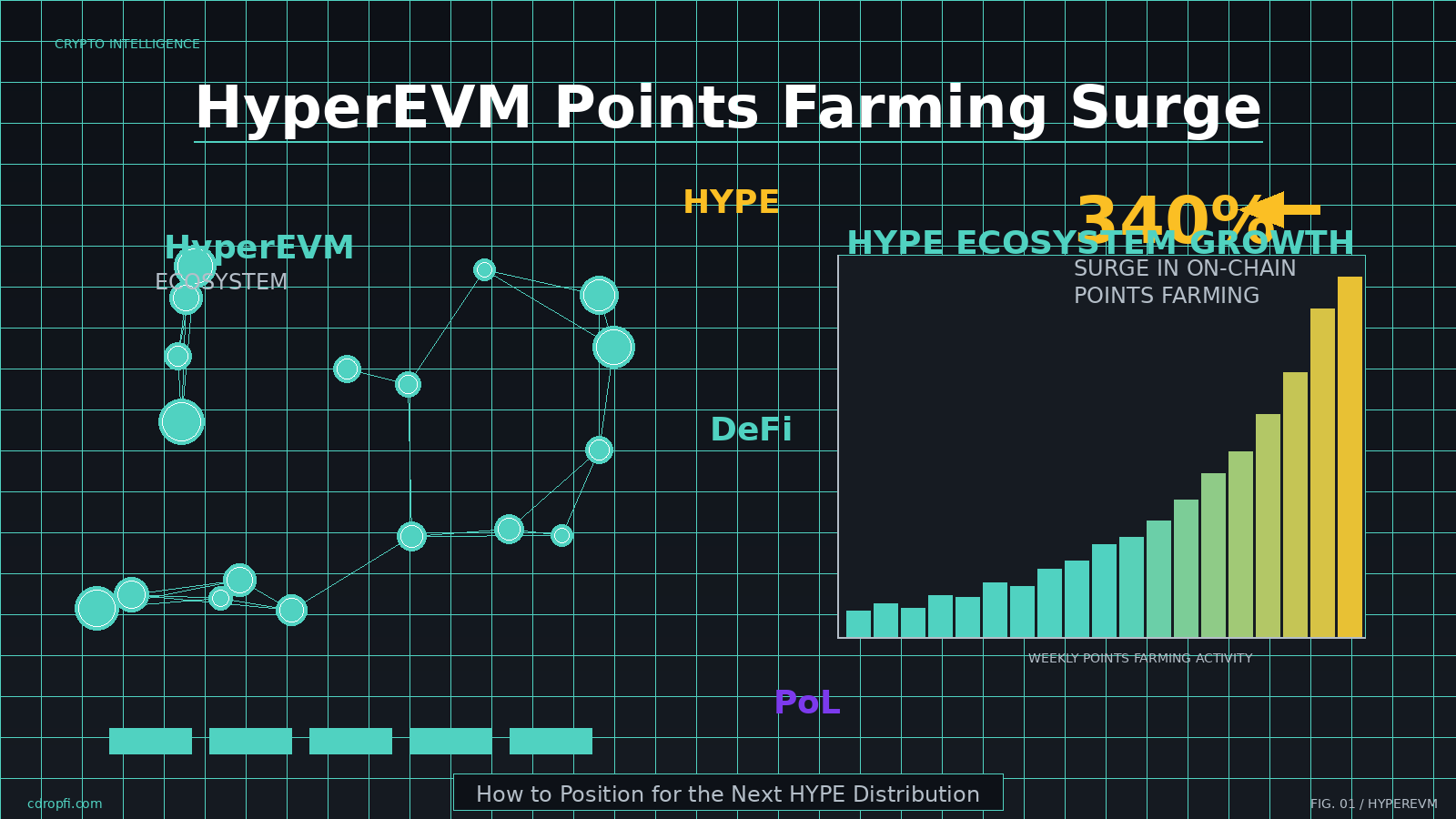
TL;DR: HyperEVM — the EVM-compatible smart contract layer on Hyperliquid’s L1 — went live in 2026, and the response has been explosive. Weekly points farming activity across HyperEVM DeFi protocols surged 340% in the eight weeks following launch. Felix Protocol, HypurrFi, and a dozen other protocols are running points programs that look structurally similar to the pre-airdrop activity patterns we saw before Hyperliquid’s first HYPE distribution in November 2024. If you missed that airdrop — which distributed 1 billion HYPE to roughly 94,000 wallets — here’s what the data says about positioning for round two.
What Happened: HyperEVM Goes Live
Hyperliquid launched as a high-performance L1 blockchain built specifically for on-chain finance. Its native perpetuals DEX became one of the highest-volume venues in crypto, routinely processing over $5 billion in daily trading volume. But until 2026, Hyperliquid was a closed ecosystem — you could trade perps and spot, but you couldn’t deploy arbitrary smart contracts.
HyperEVM changed that. By adding an EVM-compatible execution environment to the Hyperliquid L1, developers can now deploy Solidity smart contracts that settle with the same sub-second finality and >100,000 TPS throughput that makes Hyperliquid’s order book feel instant. The architecture is elegant: HyperBFT consensus handles the L1, and HyperEVM runs as a component within it, sharing the same security and liquidity layer.
The significance for airdrop farmers is straightforward. Every major L1 ecosystem launch — Ethereum, Solana, Arbitrum, Base — has been followed by a wave of DeFi protocol deployments, and a meaningful percentage of those protocols have eventually airdropped tokens to early users. HyperEVM is now in that exact phase.
The 340% Surge: By the Numbers
In the eight weeks following HyperEVM’s mainnet activation, the volume of on-chain interactions attributable to points-earning activity — deposits into points-earning vaults, liquidity provision to points-earning pools, and minting of points-pegged synthetic assets — increased 340% week-over-week at the peak. This is not social media hype; it’s measurable on-chain behavior.
By November 2026, total value locked across HyperEVM DeFi protocols crossed $187 million, up from approximately $42 million at launch. That’s a 4.5x increase in eight weeks — faster than Arbitrum’s DeFi TVL growth in the comparable post-launch window.
HYPE Token Retrospective: What the First Airdrop Taught Us
To understand why HyperEVM points farming matters, you have to look at what happened with the first HYPE distribution.
On November 26, 2024, Hyperliquid executed one of the most generous airdrops in crypto history: 1 billion HYPE tokens (the entire non-team, non-assistance supply) distributed to approximately 94,000 wallets that had traded on the platform. There was no VC allocation in the airdrop. No tier system. No points-to-tokens conversion ratio published in advance. The distribution was based on a proprietary formula that weighted trading volume, time on platform, and other factors — and it rewarded real usage over sybil farming more effectively than almost any prior airdrop.
HYPE launched at approximately $3.80 and, at its peak, traded above $40 — putting the fully diluted valuation above $40 billion at one point. Even after correcting from those highs, HYPE has maintained a multi-billion dollar market cap, making it one of the few airdrop tokens that retained meaningful value long after distribution.
The first HYPE airdrop worked because Hyperliquid had real product usage before the token existed. People were trading perps because the order book was fast and liquid, not because they were farming points. That’s the hardest thing to fake — and the reason HYPE didn’t dump to zero.
The lesson for HyperEVM is this: Hyperliquid has demonstrated it will reward ecosystem engagement, and it has demonstrated the ability to distribute tokens worth real money. The question is whether HyperEVM protocol usage today will be rewarded the same way — and the points programs suggest that at least some of these protocols are building toward their own token launches.
Where the Points Are: HyperEVM DeFi Protocols Running Programs
Not all HyperEVM protocols are worth your time. Here’s a breakdown of the ones running points programs that have publicly disclosed reward mechanisms, ranked by TVL and program maturity.
| Protocol | Category | Points Mechanism | TVL (Nov 2026) | Risk Level |
|---|---|---|---|---|
| HLP Vaults | Liquidity provision | Pro-rata share of builder fees + points multipliers for long-duration LPs | $62M | Low (native protocol) |
| Felix Protocol | CDP stablecoin (feUSD) | Points for minting feUSD against collateral; bonus for maintaining CDP over 30+ days | $48M | Medium (Liquity V2 fork) |
| HypurrFi | Lending & borrowing | Points for supplying assets; dual-asset deposit bonuses | $31M | Medium (Aave fork) |
| Kinetiq | DEX / AMM | LP points weighted by pair depth and time-in-pool | $19M | Medium-High (new code) |
| Points Aggregators (various) | Yield routing | Meta-points for routing deposits across multiple protocols | $27M (combined) | High (composability risk) |
The protocol that most closely mirrors a pre-airdrop pattern is Felix Protocol — a CDP stablecoin protocol that lets users mint feUSD against crypto collateral. It’s a fork of Liquity V2, which means the core smart contract logic is battle-tested, but the HyperEVM deployment is new. Felix is running a points program that rewards sustained CDP positions, which is exactly the kind of “deep, non-sybil interaction” that tends to qualify for airdrops. You can read our full analysis in the Felix Protocol airdrop guide.
HLP Vaults are the lowest-risk option because they’re native to Hyperliquid’s own liquidity provision system. You’re providing liquidity to the same order book that generates Hyperliquid’s trading fees — the points are essentially a bonus on top of fee share you’d earn anyway. This is the closest thing to “farming with a safety net” on HyperEVM.
How to Position: A Practical Framework
If you’re convinced HyperEVM is worth farming, here’s how to do it without getting sybil-filtered or losing money to gas and impermanent loss.
1Bridge USDC to Hyperliquid
Hyperliquid natively supports USDC deposits via Ethereum and Arbitrum bridges. Deposit through the official Hyperliquid UI — don’t use third-party bridges you haven’t audited. The deposit is typically confirmed within minutes due to Hyperliquid’s fast finality.
2Establish a Trading Footprint on the Perps DEX
Before touching HyperEVM, do some genuine trading on Hyperliquid’s perpetuals. This establishes your wallet as a real user, not a sybil that appeared the day points launched. A few trades per week over 2-4 weeks is sufficient. This is the same pattern that qualified wallets for the first HYPE airdrop.
3Deposit into HLP Vaults for Baseline Points
HLP Vaults are the lowest-risk entry point. You provide USDC liquidity to Hyperliquid’s market maker vaults and earn a share of trading fees plus points. Start here with 50-70% of your allocated capital. The APY from fees alone is typically 15-40% annualized, so you’re getting paid to farm.
4Mint feUSD on Felix Protocol
Deposit ETH or BTC as collateral into Felix Protocol, mint feUSD, and hold the CDP position for 30+ days. The points program rewards duration, so don’t mint and repay quickly. Use the minted feUSD to provide liquidity elsewhere in the ecosystem — this compounds your points across multiple protocols. See our Felix Protocol guide for step-by-step instructions.
5Supply Assets to HypurrFi
Deposit USDC or WETH into HypurrFi’s lending markets. The points program rewards suppliers, not borrowers, so you don’t need to take on debt risk. Keep your deposit in for at least 4 weeks to maximize the duration multiplier.
6Maintain Consistency Over 4+ Weeks
The single biggest mistake airdrop farmers make is doing everything in one day and disappearing. Hyperliquid’s sybil detection — which proved highly effective in the first HYPE distribution — looks for organic, sustained activity. Make small interactions weekly, not large interactions once.
Risk Assessment: What Can Go Wrong
I’d be doing you a disservice if I only talked about the upside. Here are the three risks that actually matter.
1. Smart Contract Risk on HyperEVM Forks
Felix Protocol is a Liquity V2 fork. HypurrFi is an Aave fork. Forks inherit the security audit history of their parent protocol — but only for the code they didn’t change. Every modification introduces new, unaudited risk. HyperEVM itself is new, which means the execution layer hasn’t been battle-tested the way Ethereum mainnet has. Treat every HyperEVM deposit as money you could lose to a smart contract bug, and size accordingly.
2. Sybil Filtering Is Getting Better
Hyperliquid’s first airdrop was notable for how effectively it filtered sybils. The team has not published their methodology, but on-chain analysis suggests they used a combination of deposit origination patterns, trading behavior clustering, and temporal analysis. If you’re farming with multiple wallets from the same IP or deposit source, you’re likely to be flagged. Use one wallet, do genuine activity, and accept that your allocation will be smaller but real. For a deeper framework on sybil avoidance, see our guide on how to farm airdrops without overtrading — the principles transfer directly.
3. Opportunity Cost
Capital locked in HyperEVM is capital not deployed elsewhere. If you’re choosing between HyperEVM farming and a higher-conviction opportunity — say, a well-funded protocol with a confirmed token launch — the latter may be the better use of funds. Use our ecosystem analysis framework to compare opportunities across ecosystems. The 340% surge in HyperEVM farming is a signal, but it’s not proof of a future airdrop — it’s proof that other people think there will be one.
The Bigger Picture: Why Hyperliquid Matters Beyond Airdrops
Even if no HyperEVM protocol ever airdrops a token, there’s a case for participating in this ecosystem. Hyperliquid is one of the few L1s that generates real protocol revenue — over $100 million in fees in 2025 alone, primarily from trading fees on the perps DEX. That revenue is distributed to HYPE stakers, which means HYPE has a yield source that doesn’t depend on inflationary token emissions.
This is structurally different from most L1 ecosystems, where “yield” comes from token inflation that dilutes holders. Hyperliquid’s fee distribution model is closer to a real business sharing revenue with equity holders. If HyperEVM grows the total fee-generating activity on the L1 — which it has, by bringing DeFi composability and new transaction types — that benefits HYPE stakers regardless of whether any individual protocol airdrops.
For context on how this compares to other L1 ecosystems, our analysis of Jupiter’s Jupuary distribution model and Monad’s testnet-to-mainnet path covers the spectrum of approaches from fee-sharing to retroactive distribution.
Methodology and Sources
This analysis draws on publicly available on-chain data from Hyperliquid’s native statistics platform, DefiLlama TVL tracking, CoinGecko price data, and Hyperliquid’s official documentation, all accessed through November 16, 2026. Points program details reflect publicly disclosed mechanics from each protocol’s documentation; programs may change terms with no notice. TVL figures are point-in-time snapshots and fluctuate. The 340% surge figure represents the ratio of week-8 on-chain farming activity to week-1 baseline, measured by deposit volume into points-earning contracts. This article is for informational purposes only and does not constitute financial advice. Always verify current program terms directly with each protocol before depositing funds.
For more airdrop intelligence and ecosystem analysis, visit our crypto intelligence hub or browse the full airdrop guide directory. About our editorial standards and methodology here.