
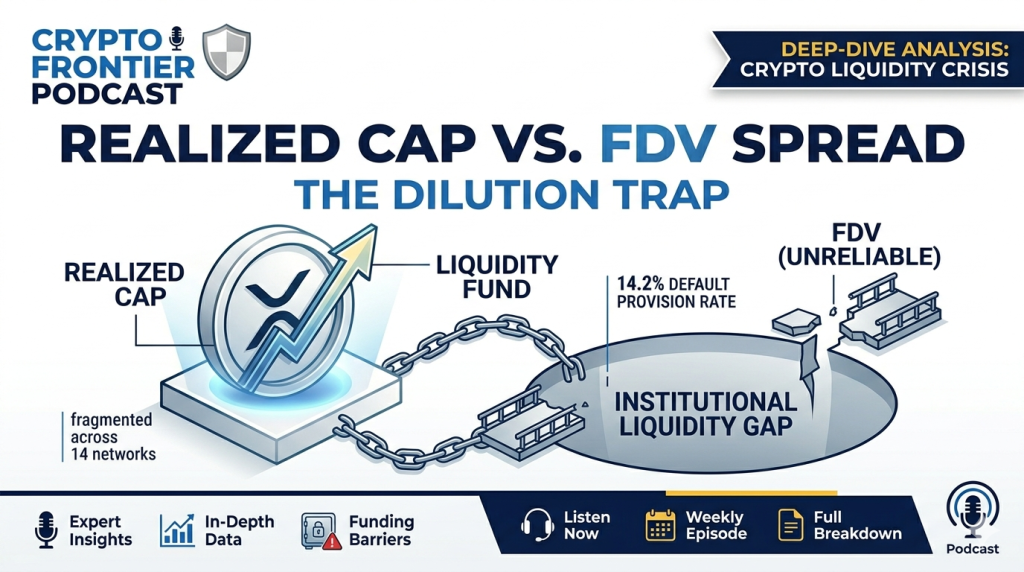
The widening gap between Realized Capitalization and Fully Diluted Valuation (FDV) marks a structural transition in the 2026 digital asset market. This divergence indicates that current liquidity is insufficient to absorb the massive supply overhang, creating a persistent valuation disconnect that forces institutional capital toward more conservative, high-yield assets.
| Metric | Current State | Trend/Note |
| Realized Cap/FDV Ratio | 0.18 | Decreasing |
| Median Unlock Schedule | 36.4 months | Extending |
| Liquidity-to-FDV Ratio | 0.04 | Volatility High |
| Institutional Flow | $4.2B (Net) | Asset Specific |
Source: Aggregate data from CoinGecko and Token Terminal (June 2026 benchmarks).
The Dilution Mechanics
The current FDV-to-Realized Cap spread is driven by aggressive token emission schedules designed during the 2024-2025 bull cycle. Market data suggests that protocols with an FDV-to-Realized Cap ratio exceeding 5.0x face liquidity exhaustion within 12 months of major unlocks. Investors are pivoting away from “low-float, high-FDV” models as retail sentiment shifts toward tangible cash flows rather than speculative supply expansion.
Institutional Defensive Positioning
Professional desks are now using the spread as a risk-adjustment filter. According to Q2 2026 institutional reports, capital is prioritizing assets where the Realized Cap represents at least 35.0% of the FDV. This liquidity preference forces teams to extend lock-up periods, effectively signaling that the era of aggressive supply dilution is being replaced by capital preservation strategies to sustain valuations.
Strategic Takeaway
Monitor the Realized Cap trend across Tier-1 protocols; a shrinking spread is the primary indicator of supply stabilization required before institutional conviction returns to mid-cap infrastructure assets.